The site
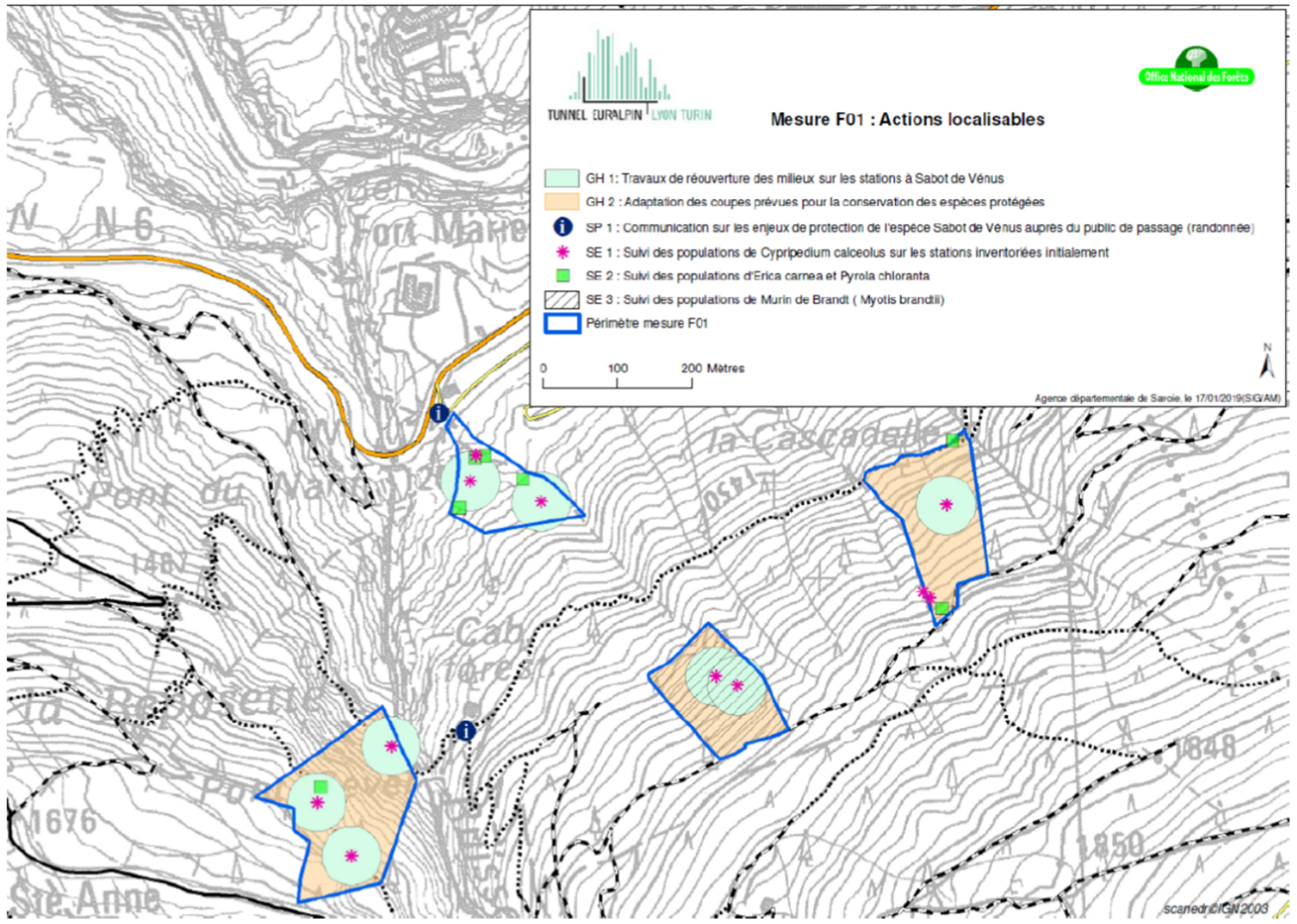
The site comprises four distinct forest plots located above Fort Marie-Thérèse in Avrieux. Its total area is 8.51 hectares. It is situated within a large forested area, where vegetation varies depending on the sector: pine and fir trees, with spruce and beech also appearing. Each of these four plots contains small gaps or clearings.
Key issues
The boundaries of this compensation site were defined based on the presence of the Lady’s Slipper Orchid (Cypripedium calceolus), whose preservation represents the main objective of the compensatory measure. This emblematic flower has been identified in various locations where vegetation dynamics vary: small permanent clearings, forest gaps, but also open or even denser woodland, sometimes composed of several layers, which may reduce ground-level light. The closure of such habitats would be detrimental to the Lady’s Slipper Orchid. Conversely, a sudden opening of the canopy within or around its populations could also have negative medium-term effects on the species. The possibility of cable logging operations, if not properly regulated and aware of the species’ presence, could cause soil impacts on the Lady’s Slipper Orchid during the extraction of felled timber. Finally, the proximity of trails near some populations creates a local risk of plant picking. Some of these threats also concern other species present on the site, particularly the Snow Heath and Green-flowered Wintergreen (flora), as well as Brandt’s bat, a notable bat species.
Partners
The municipality of Avrieux
Objectives
Achieve or maintain a favourable conservation status for existing protected plant species habitats and populations.
Raise public awareness about the protection of target plant species.
Monitor the evolution of animal and plant species populations on the site.
Discover…
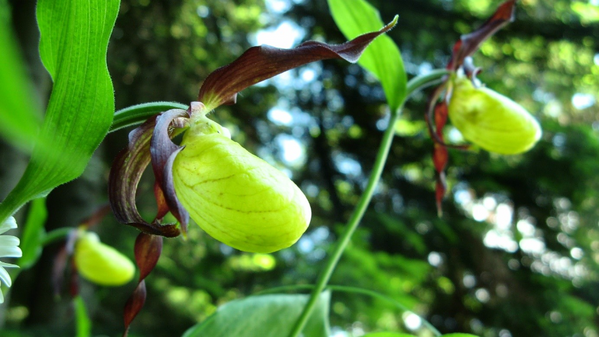
The Lady’s Slipper Orchid A true star and highly photogenic, it is undoubtedly one of the most iconic flowers of the Alps. It is instantly recognizable thanks to the large, swollen yellow pouch of its flower, which resembles a slipper and gives the plant its name. Very rare and protected at both national and European levels, it grows in semi-shaded habitats within beech forests, beech–fir forests and Scots pine woodlands, mainly on calcareous soils.