The site
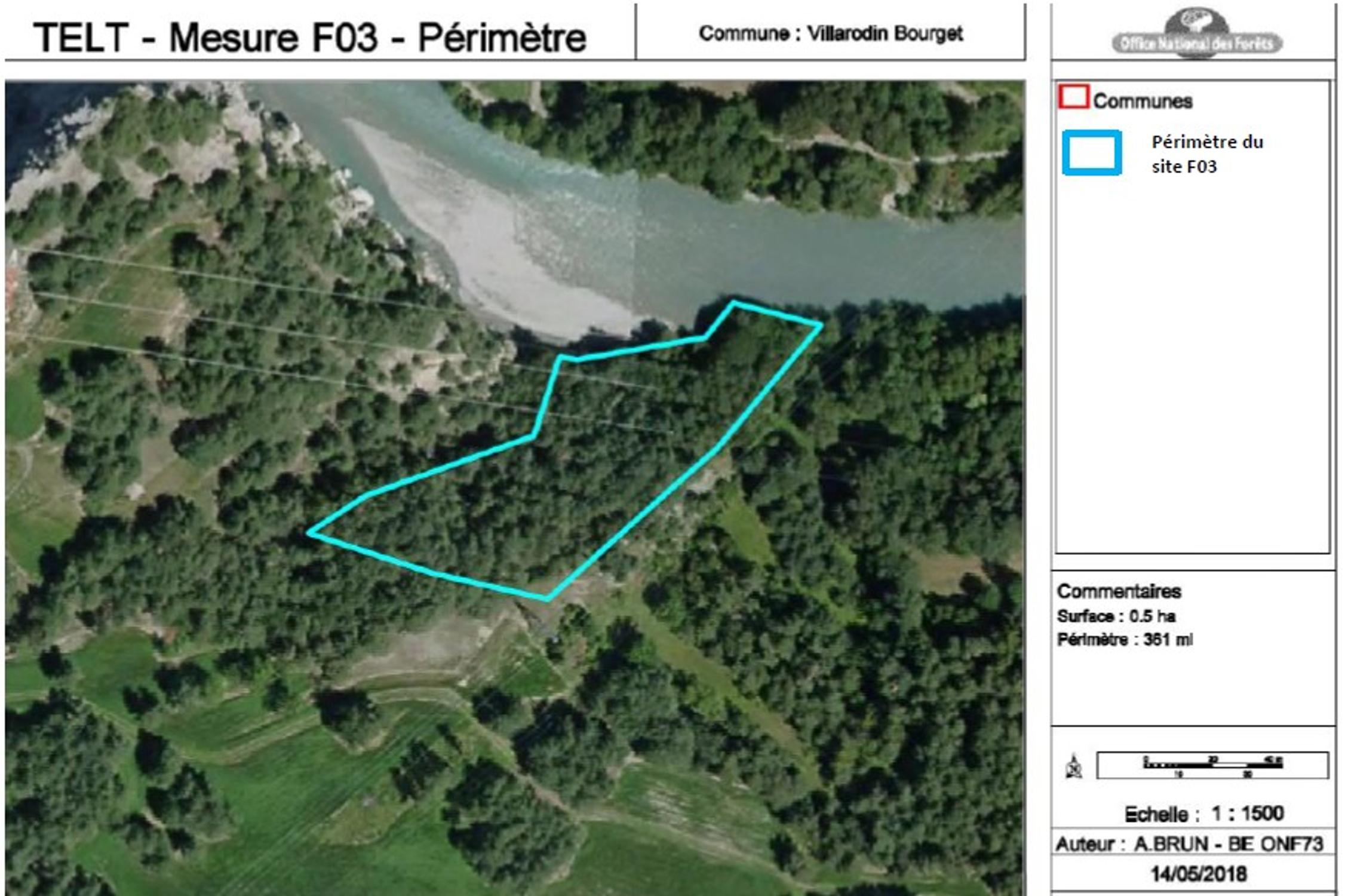
This group of small forest plots is located between the Arc River and the final disposal site of Les Tierces in the municipality of Villarodin-Bourget, forming a protected area of 0.5 hectares on the edge of a site operated by TELT. It is composed of a Scots pine forest on a north-facing slope, bordered by an alluvial stand of white alder, with a gradient from drier conditions to slightly more humid ones observed as the slope descends towards the Arc. The sparse undergrowth includes spruce regeneration.
Key issues
This small forest site is of interest because it contains exactly the same forest habitats and species that are disturbed by the exploitation of the neighbouring disposal site. It can therefore serve as a refuge for these species, both fauna and flora, including through experimental translocation of stumps and deadwood on which Green Buxbaumia (Buxbaumia viridis), a protected moss species, grows. Pine forests developing on north-facing slopes (ubac) constitute a remarkable biotope. Their potential to host rich and noteworthy biodiversity increases with forest ageing: species composition can shift from relatively common bird and bat species to more specialised communities typical of mature forests. Ageing also promotes the accumulation of deadwood on the ground, which, as it decomposes, supports an entire food chain starting with saproxylic beetles, i.e. insects feeding on dead wood. Currently, the stand is already favourable to Green-flowered Wintergreen and Single-flowered Wintergreen, two notable plant species—one of which is regionally protected—that thrive in moderately dry, shaded or semi-shaded conditions.
Objectives
Achieve or maintain a good conservation status for habitat types and for existing populations of protected plant species
Monitoring the evolution of habitat types and plant species populations on the site
Discover…
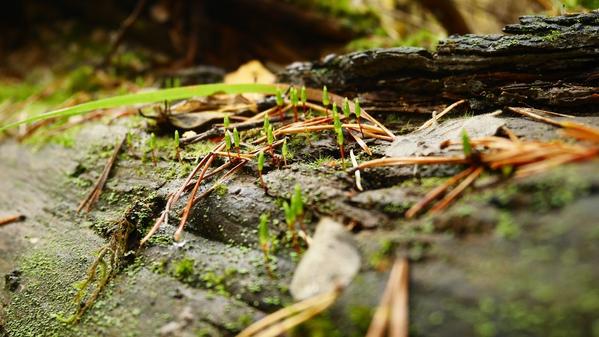
The Green Buxbaumia (Buxbaumia viridis) is a bryophyte species, meaning a moss. Lacking visible leaves, it is identified by its tiny sporophytes, which appear a few days after a rainfall event and measure only 7 to 8 mm in height. It is therefore particularly difficult to locate. Fortunately, its habitat is well known: it grows almost exclusively on decaying conifer wood, and more rarely on hardwood, in shaded conditions, most often between 900 m and 1,800 m in altitude. Its sporophytes develop in conditions of high atmospheric humidity, so it is pointless to search for it during dry periods.