Objectives of the monitoring
The interactions between the water of a watercourse, its channel and its banks give rise to a specific biodiversity: that of aquatic environments. A variety of external factors affecting each of these aspects—water flows, whether natural or influenced by regulation structures such as dams; the nature of the channel, meaning its morphology and substrates (gravel, rocks, sand, etc.); and the vegetation of the banks and channel—can influence the richness of these environments. These factors may be either natural, as a flood can significantly alter the channel of a watercourse, or artificial and linked to human activities. Such activities can have both direct effects (modification of the channel and banks) and indirect effects (influence on flow regimes, water quality, etc.). The monitoring carried out by TELT seeks to characterise these potential effects in order to confirm the effectiveness of the preventive measures implemented for the preservation of aquatic environments and, where appropriate, identify the relevance of corrective measures.
The key indicator
Physical, morphological and ecological criteria
The assessment of the quality of aquatic and wetland habitats is based on three criteria, considered of equal importance. The physical criterion determines whether the topography of the watercourse creates flow conditions—in terms of water velocity and depth—favourable to the development of fish life, as well as the presence or absence of slope breaks (dams, weirs, waterfalls, etc.) that may hinder ecological continuity. The morphological criterion focuses on flow patterns, the presence of shelters and habitats, and substrate characteristics. The ecological criterion concerns vegetation development, bank characteristics, and the presence of invasive alien species.
Partners
The consultancy firm commissioned by TELT: STE
Characteristics of the monitoring
Physical criterion: water depths, flow velocities and topography; Morphological criterion: flow patterns, sediment deposits and substrates; Ecological criterion: vegetation, refuges and lateral connectivity
These criteria are divided into three categories, making it possible to assess the level of functionality of the aquatic environment as good, moderate, or poor. The least favourable criterion is retained to determine the overall condition of the river section with regard to its capacity to support the development of aquatic life. An assessment of the quality of potential spawning grounds is also carried out.
Discover…
The morphology of watercourses
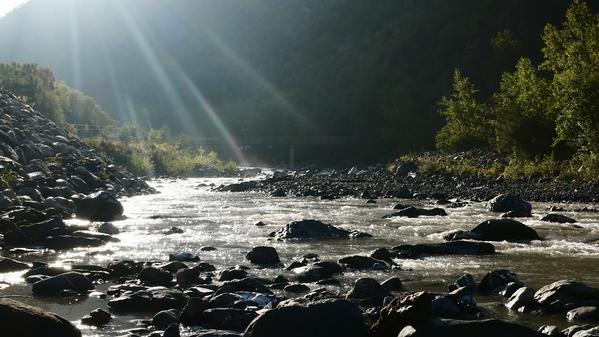
The development of fish life depends significantly on the diversity that a watercourse offers in its flow conditions and in the characteristics of its riverbed. In a stream or river, water can flow in different ways: pools, riffles, cascades, and so on. These are referred to as flow patterns. The presence of several types of flow patterns, both slow and fast, promotes water oxygenation as well as the formation of shelter and refuge areas, making the watercourse more hospitable. Morphology also focuses on the “substrate/support” pair: this refers to what the riverbed is made of, such as rocks, stones, pebbles, sand or silt, and what covers them, for example aquatic vegetation, dead leaves, woody debris or overhanging vegetation. Here again, diversity promotes the development of fish life.