Objectives of the monitoring
Fish population monitoring aims to characterise fish communities in watercourses. Fish populations are influenced by a large number of factors, such as habitat morphology (riverbed characteristics, shading, etc.) and hydraulic conditions (for example, flow velocities), which directly determine the availability of spawning and feeding habitats. As fish are part of the aquatic food chain, they can also be indirectly affected by the same factors that may alter hydrobiological quality, such as the physicochemical quality of surface waters. Fish population monitoring therefore complements all the other water-related monitoring programmes carried out by TELT.
However, fish population monitoring is also, in some cases, strongly influenced by restocking activities carried out by fishing associations. The monitoring conducted by TELT is intended to detect possible changes in fish communities, but its interpretation must also take into account many other factors in order to determine the causes of such changes where relevant. Should TELT’s activities be proven to have an impact on fish populations, TELT would implement appropriate fish restocking measures.
The key indicator
Biomass per hectare
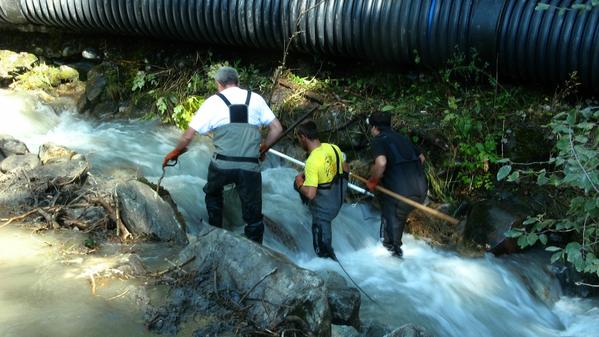
Fish surveys are carried out using electrofishing techniques: fish are attracted and temporarily stunned by an electric current before being released. This regulated method makes it possible, when an entire section of a watercourse can be waded, to capture all or nearly all of the fish present. All captured fish are measured and weighed. Biomass per hectare corresponds to the total weight of the fish divided by the surface area of the river section surveyed. A fish-rich river therefore has a high biomass per hectare.
Partners
The consultancy firm commissioned by TELT and its specialised subcontractor: Géotec and Giroud
Characteristics of the monitoring
Species Abundance Size Biomass Density/ha Biomass/ha River Fish Index (RFI)
Fish population quality is not assessed solely through biomass: the type and diversity of species present, as well as their distribution across different size classes, which makes it possible to estimate the age of the fish, provide a better understanding of the long-term viability and sustainability of fish communities.
Discover…
The different fish species: naturally occurring or introduced by humans?
Knowledge of fish restocking activities carried out by fishing associations helps to better understand the extent to which fish populations are naturally self-sustaining or artificially supported. However, even in the absence of information on this aspect, some species are unmistakable: they can only be present as a result of restocking operations. This is the case, for example, with the Rainbow Trout, which originates from North America and was introduced into Europe, where the conditions required for natural reproduction are generally not met.
Certain characteristics also make it possible to distinguish Brown Trout specimens native to rivers and streams of the Mediterranean basin from those of the Atlantic basin. In the case of the Maurienne Valley, trout originating from the Atlantic basin are therefore also considered to have been introduced.